
 By
By 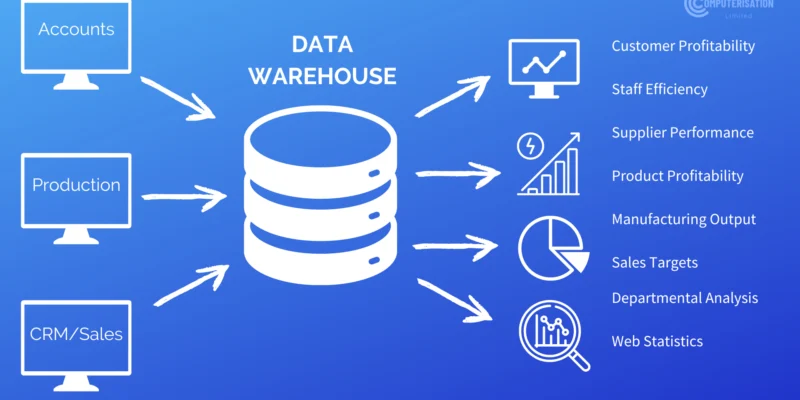
If you have ever asked, “what is a data warehouse?” it is a centralized system that collects and stores large volumes of structured data from multiple sources for analysis and reporting. Unlike an operational database that handles day-to-day transactions, a data warehouse is built specifically for answering business questions regarding sales trends and regional growth.
Think of it this way: your database is the cash register that processes every sale in real time. Your data warehouse is the accountant’s office where all those transactions get organized, cleaned, and turned into business intelligence.
Data Warehouse vs Regular Database: The Key Difference
| Feature | Operational Database | Data Warehouse |
| Primary purpose | Run day-to-day operations | Analyze historical data |
| Data age | Current, real-time | Historical – months to years |
| Data sources | Usually one application | Multiple systems integrated |
| Query type | Simple, fast (insert/update/select) | Complex, slow (aggregations, joins) |
| Optimized for | Write speed and reliability | Read speed and analytical queries |
| Example | PostgreSQL, MySQL (your app’s database) | Snowflake, BigQuery, Redshift |
How a Data Warehouse Works: The ETL Process
Data does not teleport into a warehouse. It goes through a process called ETL – Extract, Transform, Load:
- Extract: Pull raw data from source systems (your CRM, e-commerce platform, ERP, marketing tools, etc.)
- Transform: Clean it, standardize formats, remove duplicates, apply business rules, and join related data together
- Load: Write the transformed data into the warehouse where analysts and BI tools can query it
Modern data stacks sometimes use ELT instead – loading raw data first, then transforming it inside the warehouse using SQL. Tools like dbt (data build tool) have made this approach popular because warehouses are now powerful and cheap enough to handle transformation at scale.
Key Components of a Data Warehouse
| Component | What It Does | Example Tools |
| Data Sources | Systems that generate raw data | Salesforce, Shopify, Google Ads, databases |
| ETL / ELT Pipeline | Extracts, cleans, and loads data | Fivetran, Airbyte, dbt, AWS Glue |
| Storage Layer | Where transformed data lives | Snowflake, BigQuery, Redshift |
| Semantic Layer | Defines business metrics consistently | dbt metrics, LookML, AtScale |
| BI / Reporting Layer | Visualizes and queries warehouse data | Looker, Tableau, Power BI, Metabase |
Data Warehouse vs Data Lake vs Data Mart
| Feature | Data Warehouse | Data Lake | Data Mart |
| Data type | Structured, cleaned | Raw – structured + unstructured | Structured, subject-specific |
| Users | Analysts, BI teams | Data scientists, engineers | Specific business unit (e.g. marketing) |
| Schema | Defined before loading | Defined when reading | Defined before loading |
| Cost | Higher (processing + storage) | Lower (cheap object storage) | Lower (subset of warehouse) |
| Best for | Business reporting, dashboards | ML training data, raw archiving | Departmental reporting (sales, HR) |
Real-World Use Cases
Retail: A retailer connects their POS system, e-commerce platform, loyalty program, and inventory system into a warehouse. Analysts can then ask: which products sell better in-store vs online? What is the lifetime value of loyalty members vs non-members?
Healthcare: Hospital systems consolidate patient records, lab results, billing data, and appointment histories. A data warehouse enables population health analysis: which patient groups have the highest readmission rates?
Finance: Banks combine transaction data, account metadata, and customer profiles. Fraud detection models run against the warehouse; executives get daily dashboards of portfolio performance without ever touching the operational systems.
Top Data Warehouse Tools in 2026
- Snowflake: The most popular cloud data warehouse. Separates storage and compute, scales seamlessly, and works with all major cloud providers. Strong ecosystem of partners and integrations.
- Google BigQuery: Serverless – no infrastructure to manage. Excellent for teams already on Google Cloud. Pricing can be unpredictable without query cost controls.
- Amazon Redshift: Deep AWS integration. Good choice if your stack is heavily AWS-based. More infrastructure management than Snowflake or BigQuery.
- Databricks Lakehouse: Bridges the gap between data lake and data warehouse. Increasingly popular for teams that need both ML workloads and BI reporting from a single platform.
Is a Data Warehouse Right for Your Business?
You probably need a data warehouse when:
- You have data in multiple systems (CRM, finance, marketing, operations) and cannot get a unified view
- Your analytics team spends more time pulling data together than actually analyzing it
- Your operational database slows down when someone runs a complex report on it
- You want to track trends over time – not just the current state
You probably do not need one yet when your data all lives in one or two systems, your team is small, and a well-structured operational database with a BI tool on top handles your reporting needs. Start there and add a warehouse when you outgrow it.









Comments